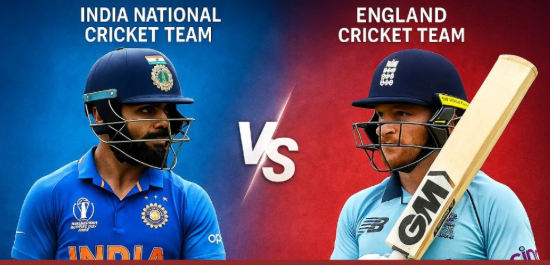
The rivalry between the England Cricket Team and the India National Cricket Team is one of the most historic and evolving contests in world cricket. From colonial-era beginnings to modern-day global showdowns, their encounters reflect both cricketing excellence and changing dynamics in international sport. Over decades, this rivalry has grown stronger, producing iconic matches, legendary players, and unforgettable moments across all formats.
Latest Matches
Tournament
Venue
Date
England Score
India Score
Result
Series
T20 World Cup 2026
Wankhede Stadium, Mumbai
Mar 5, 2026
246/7 (20 ov)
253/7 (20 ov)
India won by 7 runs
T20 World Cup 2026
India tour of England 2025
The Oval, London
Jul 31–Aug 4, 2025
247 & 367
224 & 396
India won by 6 runs
Bilateral Test
India tour of England 2025
Old Trafford, Manchester
Jul 23–27, 2025
669
358 & 425/4
Match drawn
Bilateral Test
India tour of England 2025
Lord’s, London
Jul 10–14, 2025
387 & 192
387 & 170
England won by 22 runs
Bilateral Test
India tour of England 2025
Edgbaston, Birmingham
Jul 2–6, 2025
407 & 271
587 & 427/6d
India won by 336 runs
Bilateral Test
India tour of England 2025
Headingley, Leeds
Jun 20–24, 2025
465 & 373/5
471 & 364
England won by 5 wkts
Bilateral Test
England tour of India 2025
Wankhede Stadium, Mumbai
Feb 2, 2025
97 (10.3 ov)
247/9 (20 ov)
India won by 150 runs
Bilateral T20I
Overall Rivalry Snapshot Across All Formats
Format
Matches Played
India Wins
England Wins
Draws / Ties / NR
India Win %
Key Note
Test
141
37
53
51 Draws
26.2%
England leads historically, but India dominant in last decade
ODI
110
61
44
2 Ties, 3 NR
55.5%
India clear leaders
T20I
30
18
12
0
60%
India surging ahead
Overall
281
116
109
56
~41%
Extremely balanced & intense rivalry
Top Performances
Year
Format
Top Batter (Most Runs)
Highlight Moment
2026
T20I
Abhishek Sharma (IND) – 288+ runs
India’s T20 WC semi-final thriller
2025
Test
Shubman Gill (IND) – 754 runs
Gill breaks series record in England
2025
Test
Rishabh Pant (IND) – Multiple centuries
Pant’s twin tons as WK
2024
T20I
–
India’s 68-run WC semi win
2022
T20I
–
England’s 10-wkt WC semi win
2021–22
Test
Joe Root (ENG) – Consistent anchor
India’s home dominance
2018
Test
Virat Kohli (IND) – 593 runs
Kohli’s masterclass in England
Biggest Wins & Closest Matches
Year
Format
Match Details
Margin
Type
Why It’s Memorable
2025
Test
India vs England, Edgbaston
India won by 336 runs
Biggest Win
Massive Indian batting display
2025
T20I
Wankhede, Mumbai
India won by 150 runs
Biggest T20 Win
England collapsed for 97
2026
T20I
T20 WC Semi, Wankhede
India won by 7 runs
Closest Thriller
Last-over heart-stopper
2025
Test
The Oval, London
India won by 6 runs
Closest Test
Nail-biting final day finish
2025
Test
Lord’s, London
England won by 22 runs
Close Contest
England fought back brilliantly
2024
T20I
T20 WC Semi, Guyana
India won by 68 runs
Big Win
Dominant Indian bowling
2012
T20I
Colombo
England won (India defended low)
Historical Low Score
England chased 80 all out
Early Encounters and Colonial Era Beginnings (1932–1950)
The cricketing relationship between England and India began in 1932 when India played its first-ever Test match at Lord’s. As a newly introduced team in international cricket, India faced a dominant England side that had already established itself as a powerhouse. These early encounters were largely one-sided, with England controlling most matches due to experience and superior infrastructure. However, India showed glimpses of potential through disciplined bowling and resilient batting. Players like C.K. Nayudu emerged as pioneers of Indian cricket during this time. The matches were symbolic, representing more than just sport—they highlighted the colonial connection between the two nations. Despite limited victories, India gained valuable experience that would shape its cricketing future. England continued to dominate throughout this period, but India’s gradual improvement hinted at a competitive rivalry in the years to come.
Year
Event
Winner
Venue
1932
First Test Match
England
Lord’s
1936
India Tour of England
England
England
1946
Post-War Series
England
England
India’s First Success and Growing Confidence (1951–1970)
The period from the 1950s to 1970 marked India’s rise as a competitive cricketing nation against England. India secured its first Test victory against England in 1952 in Chennai, a historic milestone that boosted confidence across the nation. This era saw improved performances from Indian players, especially spinners who adapted well to home conditions. England still maintained an overall advantage, but India began challenging them more consistently. The emergence of players like Polly Umrigar and Vinoo Mankad strengthened India’s lineup. Matches became more balanced, with drawn games and closely fought contests becoming common. India’s ability to perform better at home highlighted the importance of pitch conditions and strategy. England, on the other hand, relied on experienced players and disciplined gameplay to maintain competitiveness. This phase marked the transition from dominance to rivalry, as India started asserting itself on the global stage.
Year
Achievement
Winner
Highlight
1952
First Test Win
India
Chennai Victory
1961–62
Home Series
India
Strong Spin Attack
1967
England Tour
England
Overseas Dominance
The Golden Turning Point: 1971 Series Victory
The year 1971 is considered a defining moment in the England vs India timeline, as India secured its first Test series win in England under Ajit Wadekar’s captaincy. This historic achievement changed the perception of Indian cricket globally, proving that India could win overseas against strong opposition. Players like Sunil Gavaskar and Bhagwat Chandrasekhar played crucial roles in this success. Chandrasekhar’s exceptional bowling in the Oval Test helped India clinch the series. This victory marked the beginning of India’s confidence in foreign conditions. England, though disappointed, recognized India as a serious competitor from this point onward. The rivalry became more intense, with both teams aiming to outperform each other in every series. The 1971 triumph remains one of the most celebrated milestones in Indian cricket history and a turning point in this bilateral contest.
Year
Series
Winner
Key Player
1971
England Tour
India
Chandrasekhar
1972–73
Return Series
England
Revenge Win
The Era of Legends and Competitive Balance (1980–2000)
Between 1980 and 2000, the rivalry between England and India witnessed the rise of legendary players and a more balanced competition. India produced icons like Kapil Dev, Sachin Tendulkar, and Anil Kumble, while England relied on players such as Ian Botham and Graham Gooch. Matches during this period were highly competitive, with both teams winning series at home. Kapil Dev’s all-round brilliance and Tendulkar’s batting mastery added excitement to the rivalry. England continued to perform strongly in home conditions, but India became increasingly formidable on its own soil. The introduction of One Day Internationals also expanded the rivalry beyond Test cricket, bringing new audiences and formats into play. The contests were no longer predictable, as both teams possessed match-winning players capable of changing the game single-handedly. This era laid the foundation for modern competitive cricket between the two nations.
Period
Key Feature
Dominant Side
Iconic Player
1980s
All-rounders Era
Balanced
Kapil Dev
1990s
Batting Dominance
Balanced
Sachin Tendulkar
2000
Transition Phase
Even
Nasser Hussain
Modern Rivalry and ICC Tournament Clashes (2001–2015)
The early 21st century brought a new level of intensity to the England vs India rivalry, especially with frequent ICC tournament encounters. India’s famous 2002 NatWest Series final win at Lord’s became an iconic moment, symbolizing a fearless new generation. England, meanwhile, rebuilt its team with strong leadership and improved consistency. The rivalry expanded across formats, including ODIs and the newly introduced T20 format. India’s 2007 T20 World Cup success and England’s evolving white-ball strategy added further excitement. Test series during this period were highly competitive, with both teams winning at home. Players like Rahul Dravid, MS Dhoni, Kevin Pietersen, and James Anderson became central figures in defining outcomes. The rivalry grew beyond bilateral series, gaining global attention through ICC events and high-pressure matches.
Year
Event
Winner
Highlight
2002
NatWest Final
India
Historic Chase
2007
T20 World Cup
India
Champions
2012
Test Series in India
England
Rare Away Win
The Aggressive Modern Era and Format Evolution (2016–Present)
From 2016 onwards, the England vs India rivalry has entered an aggressive and highly competitive phase across all formats. India has dominated at home with strong spin attacks and consistent batting performances, while England has revolutionized white-ball cricket with an aggressive approach. England’s 2019 World Cup victory and India’s consistent ICC performances highlight their modern dominance. Test series have become more competitive, with memorable performances from players like Virat Kohli, Joe Root, Ben Stokes, and Jasprit Bumrah. The introduction of advanced analytics, fitness standards, and strategic gameplay has elevated the quality of matches. Both teams are now evenly matched, capable of winning in different conditions. The rivalry continues to grow with each series, attracting global audiences and maintaining its status as one of cricket’s most exciting contests.
Year
Format
Winner
Event
2018
Test Series
England
Home Advantage
2021
Test Series
India
Away Success
2022
Rescheduled Test
England
Record Chase
Iconic Players and Memorable Performances
Over the years, the England vs India rivalry has been defined by extraordinary players and unforgettable performances. Legends like Kapil Dev, Sachin Tendulkar, and Rahul Dravid have delivered remarkable innings for India, while England has produced greats like Ian Botham, Alastair Cook, and James Anderson. Modern stars such as Virat Kohli and Joe Root continue to elevate the rivalry with consistent performances. Memorable moments include Tendulkar’s centuries in England, Botham’s all-round heroics, and Stokes’ match-winning innings. These players have not only contributed statistically but have also created emotional connections with fans. Their performances often determined the outcomes of crucial matches, adding depth and intensity to the rivalry. The legacy of these iconic figures ensures that the England vs India timeline remains rich with history and inspiration for future generations.
Player
Team
Era
Contribution
Kapil Dev
India
1980s
All-round Excellence
Sachin Tendulkar
India
1990s–2000s
Batting Legend
James Anderson
England
Modern
Leading Wicket Taker
Virat Kohli
India
Modern
Consistent Performer
Conclusion
The timeline of the England Cricket Team vs India National Cricket Team rivalry showcases the transformation of cricket from a colonial sport to a global phenomenon. What began as a one-sided contest has evolved into a fiercely competitive rivalry filled with iconic matches and legendary players. Both teams have grown significantly, adapting to new formats and challenges while maintaining their rich traditions. With each passing year, the rivalry continues to produce thrilling encounters that captivate fans worldwide. As new talents emerge and the competition intensifies, England vs India remains a cornerstone of international cricket, promising even greater moments in the future.